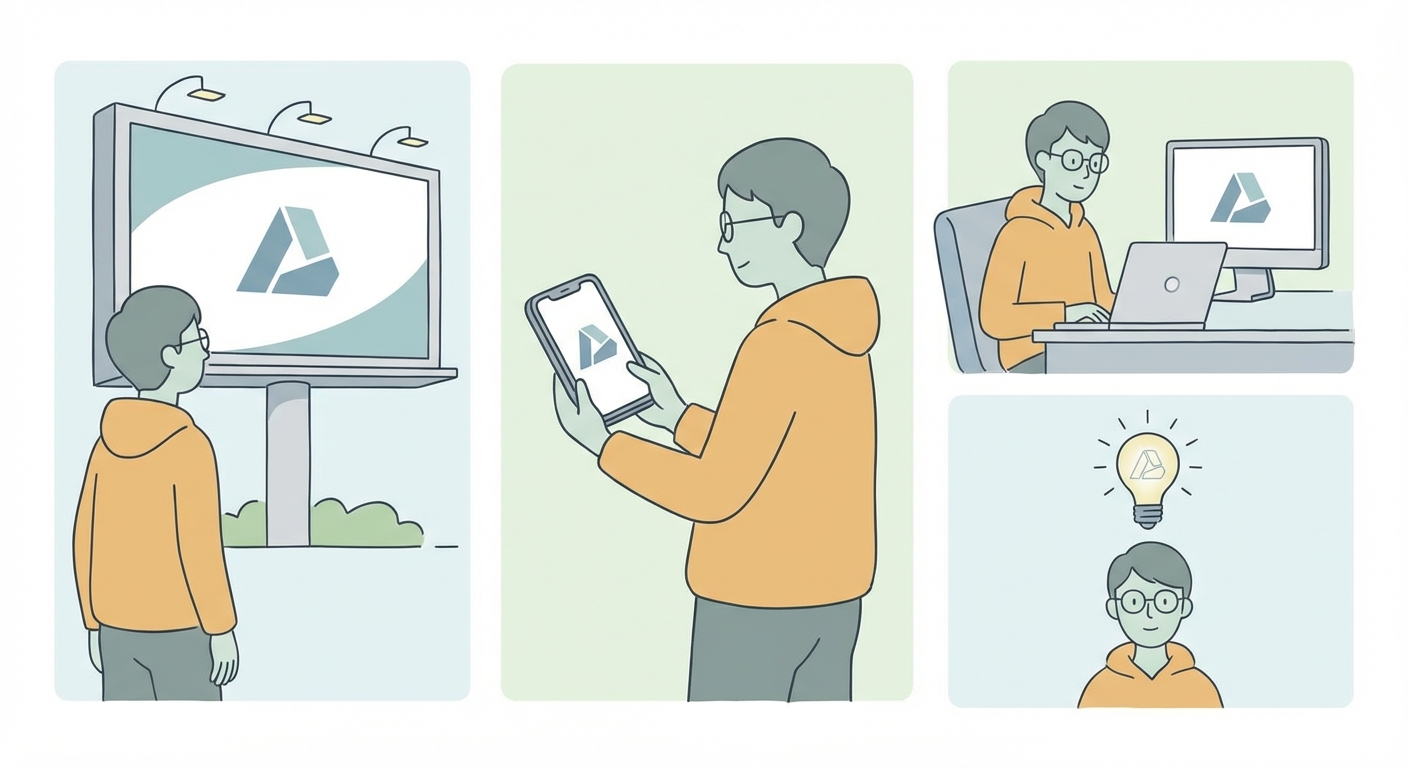
Repetition vs Variation. What's the general consensus on ...

TL;DR
- Shift to repetition of meaning combined with variation of format.
- Avoid 'Zombie Creative' by updating hooks and visuals frequently.
- Algorithmic efficiency now causes creative fatigue 35% faster.
- Anchor brand narratives to survive rising paid media costs.
- Balance brand consistency with aggressive novelty to maintain attention.
Repetition vs. Variation: What Is the General Consensus for 2026?
Here is the brutal truth about attention in 2026: It’s an endangered species.
The consensus has shifted. We are done with "volume for volume's sake." We have moved to a precise, ruthless formula: Repetition of Meaning, Variation of Format.
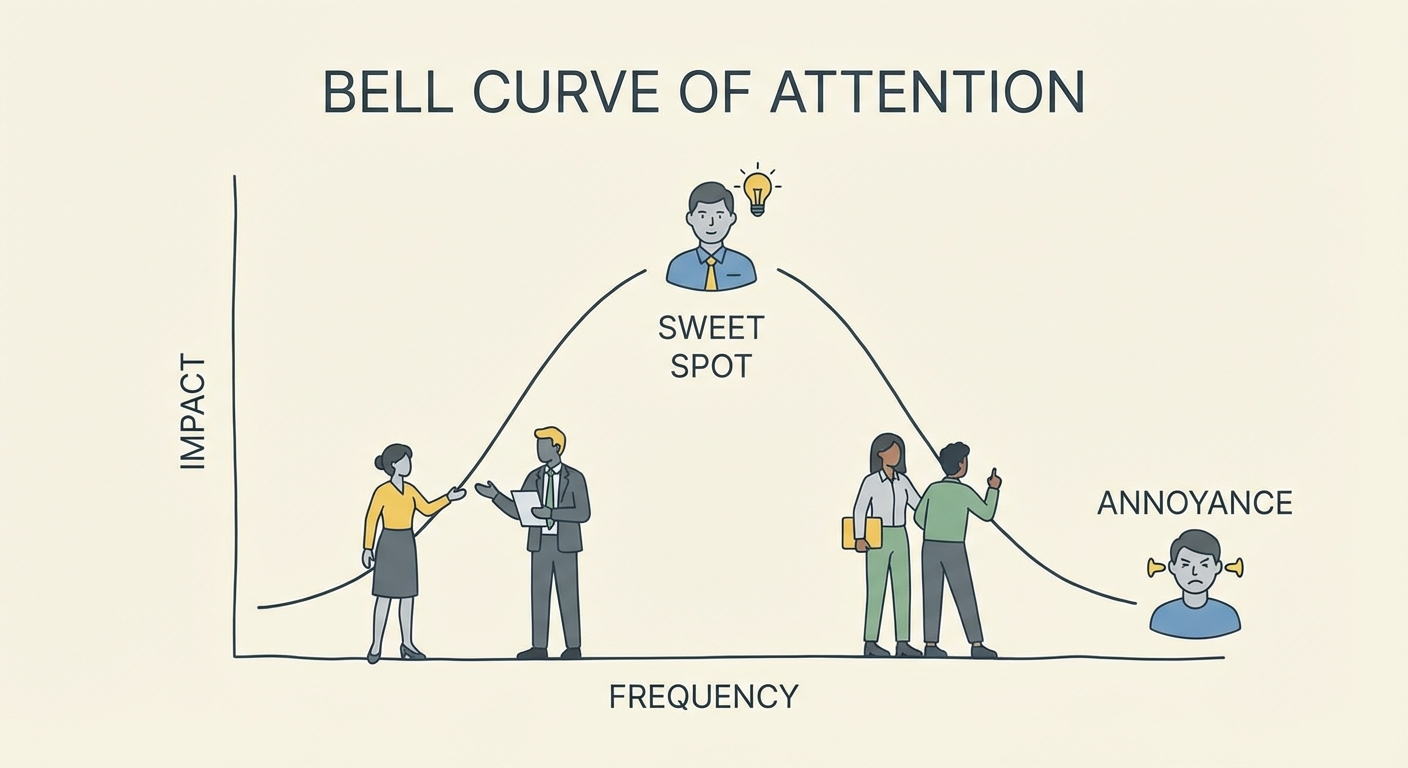
If you repeat the creative execution, you annoy the user. If you vary the core message, you confuse them. The sweet spot—and frankly, the only way to survive the rising costs of paid media—is to hammer a singular brand narrative through a kaleidoscope of constantly changing delivery mechanisms.
For years, marketers were sold a false binary. On one side, the brand purists screamed for consistency (Repetition). On the other, the growth hackers screamed for novelty (Variation).
They were both half-right. And completely wrong.
In the "Meaning Economy," where algorithmic feeds move faster than human cognition, the old playbook of "set it and forget it" is dead. If you run the same ad for three weeks, you aren't building memory structures. You are funding "Zombie Creative"—assets that look alive because they are spending money, but are actually dead on arrival.
To win now, you must anchor your brand in a repetitive core message while aggressively varying the hook, the visual, and the format to outpace algorithmic fatigue.
The "Silent Killer": Why Creative Fatigue is Faster Now
The window of opportunity for a piece of creative isn't just closing; it is slamming shut.
Five years ago, a strong Facebook ad or a viral LinkedIn post could sustain performance for weeks. Sometimes months. Today? The half-life of digital content is measured in hours.
Why the acceleration? Algorithms got too efficient for their own good. Platforms like Meta, TikTok, and Google have evolved to identify "winners" almost instantly. Once an algorithm flags an asset as high-performing, it over-serves it to your audience to maximize immediate revenue. It burns through your total addressable market's attention span in record time.
The data supports this uncomfortable reality. According to the IAB 2026 Outlook Study, ad spend is projected to grow by 9.5%. That creates an environment of unprecedented noise. You aren't just fighting for attention against your competitors; you are fighting against every other advertiser who is also cranking up the volume.
This congestion creates a phenomenon known as "Accelerated Decay." Research from Nielsen Digital Ad Ratings suggests that fatigue sets in 35% faster in algorithm-driven campaigns compared to manual placements. The machine finds the people most likely to convert, shows them your ad, and then... silence.
This leads to the "Best Performer Paradox." Most marketers feel safe when they have a "hero" asset driving 80% of their results. In reality, this is your point of maximum vulnerability. That hero asset is a single point of failure. When fatigue hits—and it will hit suddenly—your CPA doesn't just creep up. It skyrockets.
The Psychology: Mere Exposure vs. Ad Nausea
To understand why we need to split our strategy between repetition and variation, we have to look at the hardware: the human brain.
Marketing relies on the Mere Exposure Effect. This is a psychological quirk where people develop a preference for things merely because they are familiar with them. Trust is a function of predictability. If a consumer sees your brand once, you are a stranger. If they see you ten times, you are a fixture in their reality.
You cannot build a brand without repetition.
However, the brain is also a cognitive miser. It is designed to conserve energy. This brings us to Banner Blindness 2.0. When the brain encounters a stimulus it has already processed—the same image, the same headline, the same opening scene—it predicts the outcome and stops paying attention. It’s saving calories.
This is the tension. We need repetition to build trust, but we hate repetition when it becomes boring.
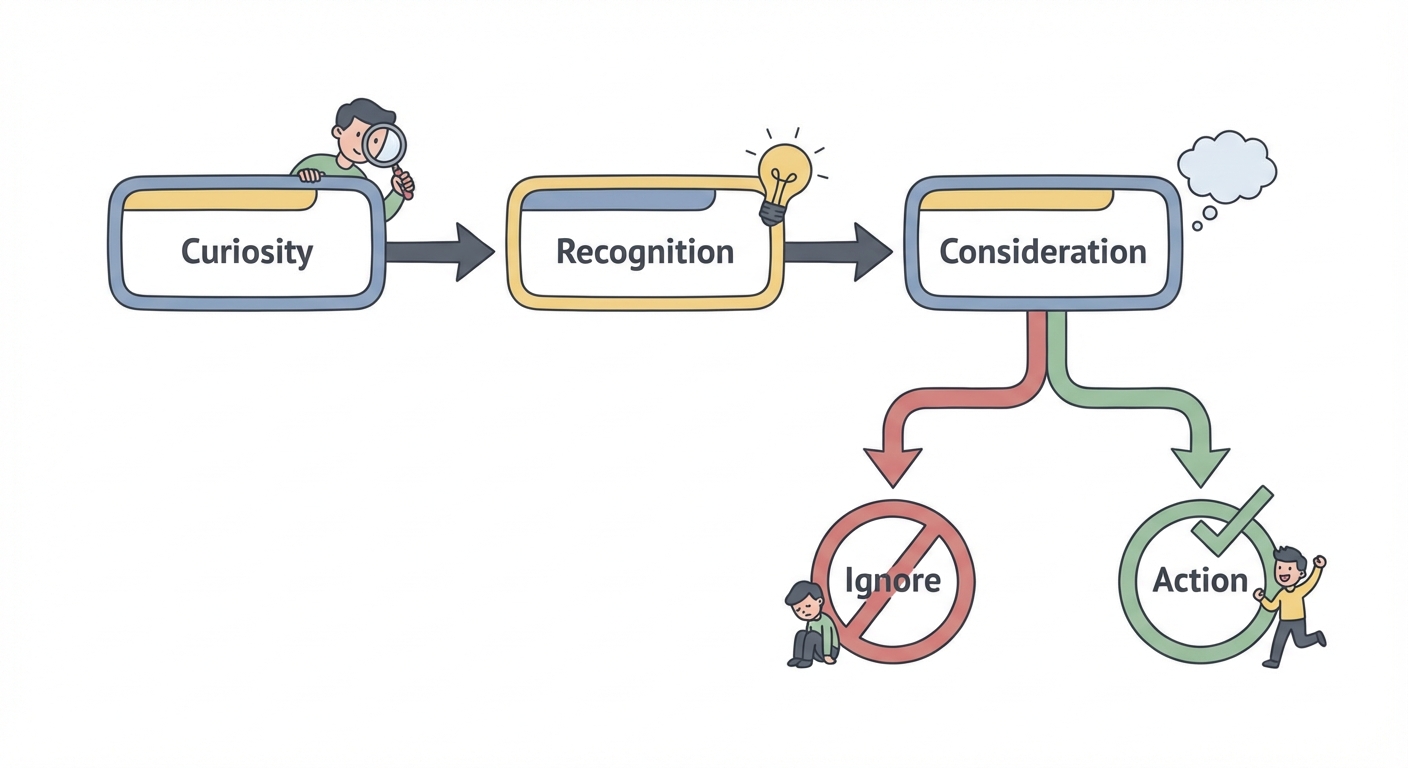
The consensus solution is to decouple the message from the visual. The user needs approximately 7 meaningful touchpoints to convert. However, they will emotionally block identical visuals after 2-3 views. The strategy? Create 7 touchpoints that feel like 7 different conversations about the same topic.
The New Rule: "Repetition of Message, Variation of Format"
If you take nothing else from this article, take this rule. It is the governing dynamic of high-performance marketing in 2026.
You must draw a hard line between what stays the same and what changes.
The Repetition (The Anchor) Your offer, your Unique Selling Proposition (USP), and your tone of voice should be granite. These elements do not change. If you sell "AI that writes like a human," you don't wake up on Tuesday and sell "Software for faster typing." Repetition of the core message ensures that when the user finally decides to buy, they know exactly what you do.
The Variation (The Sail) Everything else must be fluid. The hook, the visual style, the aspect ratio, the creator, the headline—these must change constantly.
- Hook A: "Stop wasting time writing blogs." (Pain avoidance)
- Hook B: "The secret to ranking #1 on Google." (Benefit gain)
- Hook C: "My writer quit, so I built this." (Storytelling)
The message (buy this software) is identical. The entry point is unique.
This isn't just theory. WARC Creative Effectiveness research has shown that campaigns utilizing rotating creative ideas outperform short-term optimization strategies by up to 40% over longer horizons. The brands that try to "optimize" a single asset to death eventually hit a wall. The brands that rotate fresh creative concepts keep the door open.
We also need to update the "6-Second Rule." In the past, the goal was simply to stop the scroll. Now, with platforms prioritizing retention and "shares," stopping the scroll isn't enough. You have to earn the re-watch. Variation is what keeps the user engaged long enough for the Repetition of the message to sink in.
Organic Strategy: Depth Over Frequency
For years, the loudest voices in marketing (looking at you, 2018-era GaryVee) screamed "Quantity! Quantity! Quantity!" The advice was to post 5 to 10 times a day across every platform.
In 2026, that strategy is a one-way ticket to algorithmic obscurity.
Social algorithms have fundamentally shifted their objective functions. They no longer reward raw volume; they reward retention and depth. If you post 5 shallow pieces of content a day, and users scroll past them in 0.5 seconds, the algorithm tags your account as "low quality." It throttles your reach. You are essentially spamming your own audience.
The new consensus for organic frequency is Depth > Frequency.
- LinkedIn / Instagram: 3-4x per week. Each post should be substantial. Carousels that teach, videos that analyze, or text posts that challenge a belief.
- TikTok / YouTube Shorts: 1x per day. Here, frequency still matters, but entertainment value is the gatekeeper.
The goal is to increase "Time Spent," not just "Views." Variation keeps people watching; Repetition ensures they remember who posted it. If you vary your face, your set, and your topic every single time, you are just a random entertainer. If you vary the format but keep the core thesis consistent, you become a thought leader.
How to Build a "Variation Engine" (Without Burnout)
The biggest pushback to this strategy is resources. "I'm a team of one. I can't create 20 variations for every campaign."
This is where the conversation about AI usually goes wrong. Most people use AI to generate ideas. That is a mistake. AI is terrible at original insight; it is excellent at iteration.
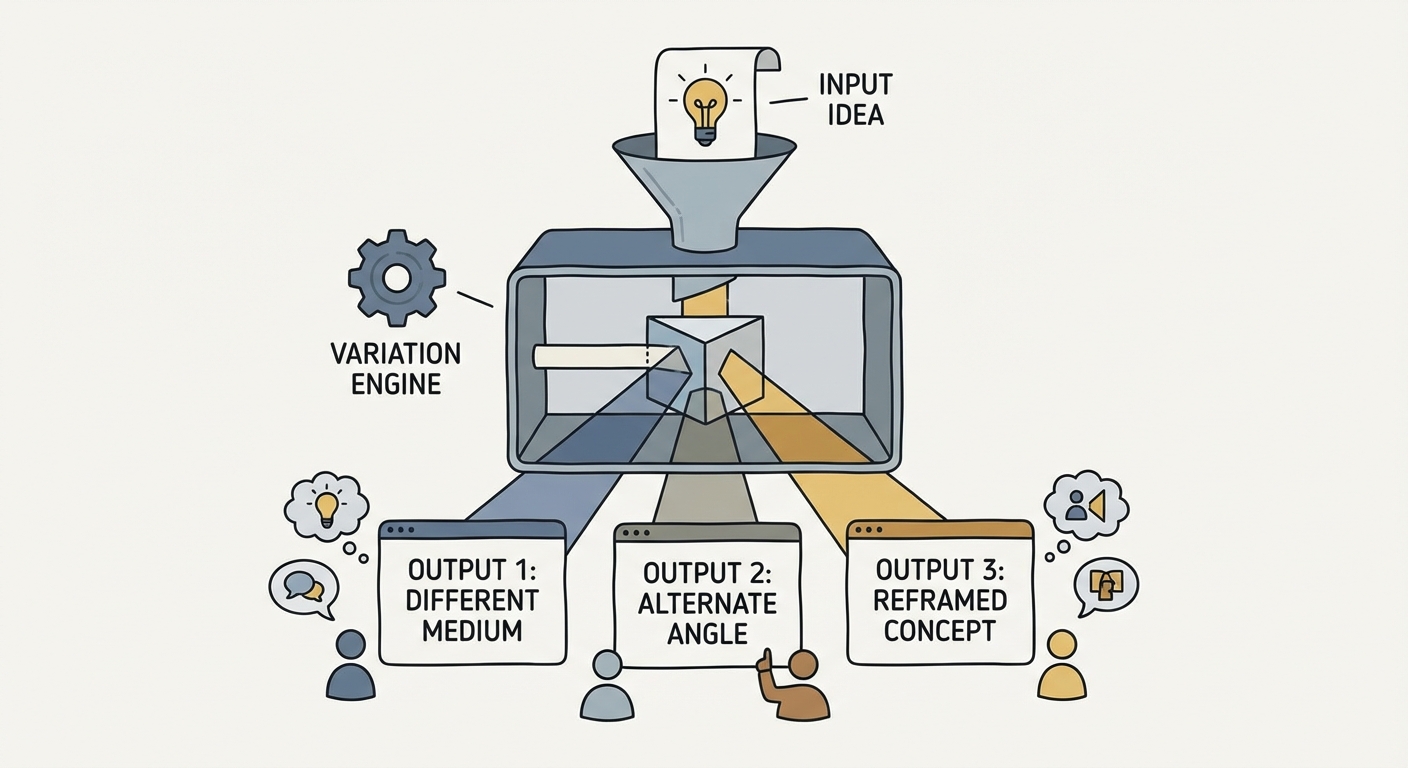
The winning workflow for 2026 is the Human-AI Hybrid. You, the human, provide the Core Idea. This is the "Repetition" part—the soul of the content. You then use AI as a multiplier to generate the "Variation."
For example, using tools for AI blog writing allows you to take one strong human idea and spin it into a dozen unique formats without diluting the voice. You aren't asking the AI to "write me a blog post about marketing." You are feeding it your thesis and asking it to reframe that thesis for a skeptical CFO, then for an excited Gen Z founder, and then as a contrarian Twitter thread.
The Variation Workflow:
- Input: You write one deep-dive Blog Post (The Core Message).
- Output 1: Extract the most controversial paragraph. That’s a LinkedIn text post.
- Output 2: Turn the subheaders into a 5-slide Carousel.
- Output 3: Record a 60-second video reacting to your own blog post.
- Output 4: An email newsletter summarizing the "One Big Thing."
You have created 4 pieces of content. You have repeated the message 4 times. But to the audience, it looks like 4 completely different interactions.
Diagnosing "Zombie Creative": When to Kill It
How do you know when you've crossed the line from "Effective Repetition" to "Annoying Redundancy"? You need to look at the metrics, and you need to look at them differently than you did in 2024.
The old advice was to let ads run for weeks to complete the "learning phase." In 2026, that is just burning cash. We operate by the 72-Hour Rule. If a variation doesn't show signs of life in 3 days, kill it.
To diagnose the problem, use Metric Triangulation:
Rising CPM + Falling CTR = Creative Fatigue. The audience is tired of looking at this image. The platform is charging you more to show it because users are ignoring it.
- The Fix: Change the Visual (Variation). Keep the Offer (Repetition).
Stable CPM + Low Conversion = Offer Fatigue. People are clicking, so the creative is fresh. But they aren't buying.
- The Fix: The creative is fine, but the message isn't resonating. You might need to pivot the angle or the offer itself.
The "Safe" Numbers. For paid ads, a frequency cap of 2.5 to 3.0 per week is the general ceiling. Beyond that, you are paying to annoy people. For organic, if your engagement rate drops by 20% week-over-week while your posting volume stays the same, you are churning. Slow down. Increase depth.
Summary: The Sweet Spot
The debate between repetition and variation is not a choice; it is a balancing act. Repetition is for branding; it builds the memory structures that lead to trust. Variation is for attention; it hacks the brain's desire for novelty to keep the door open.
In the age of AI, "average" content is invisible. The only way to survive is to be consistently present with your core truth, but perpetually fresh in how you deliver it.
Audit your last 10 posts. Did you repeat the creative so much that you became background noise? Or did you vary the message so wildly that no one knows what you actually sell?
Find the middle ground. Anchor the meaning. Spin the format.
FAQ: Common Questions on Frequency & Fatigue
1. Is it better to post more often or post better content in 2026? Depth beats frequency. Algorithms now penalize high-volume, low-retention churning. It is significantly better to post 3x a week with high engagement and deep insights than to post 7x a week with shallow content that users scroll past.
2. How many times should a user see my ad before purchasing? The "Rule of 7" still applies for meaningful touchpoints, but purely visual repetition fatigues after 2-3 views. You need roughly 7 interactions to build trust, but those interactions should look like 7 different conversations about the same topic, not the same banner ad stalking them across the internet.
3. What is the difference between creative fatigue and audience saturation? Creative Fatigue means the audience is tired of seeing your specific ad (indicated by CTR drops). Audience Saturation means you have run out of new people to show the ad to (indicated by CPM spikes). Variation fixes fatigue; broadening your targeting fixes saturation.
4. Does changing the hook count as variation? Yes, and it is often the most effective type. Data suggests 80% of video performance is determined in the first 3 seconds. Keeping the core video body the same but swapping the first 3 seconds allows you to "repeat" the high-production asset while "varying" the entry point to capture different segments of attention.