Repetition Brand Thresholds: When Familiarity Turns Into ...

TL;DR
- The Rule of 7 is outdated in high-frequency digital environments.
- Familiarity follows a bell curve known as the Wundt-Berlyne Curve.
- Excessive repetition triggers boredom and active consumer hostility.
- Mere Exposure Effect builds trust only until a specific threshold.
- Marketers must balance top-of-mind awareness with avoiding ad fatigue.
Repetition Brand Thresholds: When Familiarity Turns Into Fatigue
Marketing 101 loves the "Rule of 7." It is the safety blanket of media buyers everywhere. The old dogma states that a prospect needs to see your message seven times before they commit to a purchase.
It sounds simple. It sounds elegant. It sounds safe.
But in the current digital ecosystem, the Rule of 7 is dangerous.
In 1930, seven impressions might have taken a month. Today, a user doom-scrolling through Instagram or TikTok can hit seven impressions of your brand in forty-five minutes. We are not just battling for attention anymore; we are battling against irritation.
Repetition is biologically necessary for memory encoding—that part is true. But it is not a linear climb toward a sale. It is a bell curve. There is a mathematical limit—a specific Brand Threshold—where the warmth of familiarity curdles into the heat of hostility.
This is the difference between a brand that feels like a trusted friend and a brand that feels like a stalker.
Here is the psychology behind that tipping point, how to spot it in your data before your CPA spikes, and how to walk the fine line between "top of mind" and "blocked."
The Psychology: Why We Love (Then Hate) Repetition
To understand why your audience eventually turns on your ads, you have to understand why they liked them in the first place. It starts with biology. Specifically, Robert Zajonc’s Mere Exposure Effect.
In the 1960s, Zajonc demonstrated a fundamental quirk of the human animal: we prefer things merely because we have seen them before.
Evolutionarily, this creates safety. If you saw a strange plant yesterday and it didn't kill you, and you see it again today, your brain categorizes it as "safe." Familiarity reduces cognitive load. It takes less glucose for the brain to process a known entity than a new one.
This is why the first few times a user sees your ad, trust increases. They aren't necessarily analyzing your USP; they are simply registering your existence as "non-threatening."
However, this affection is not infinite. It follows the Wundt-Berlyne Curve.
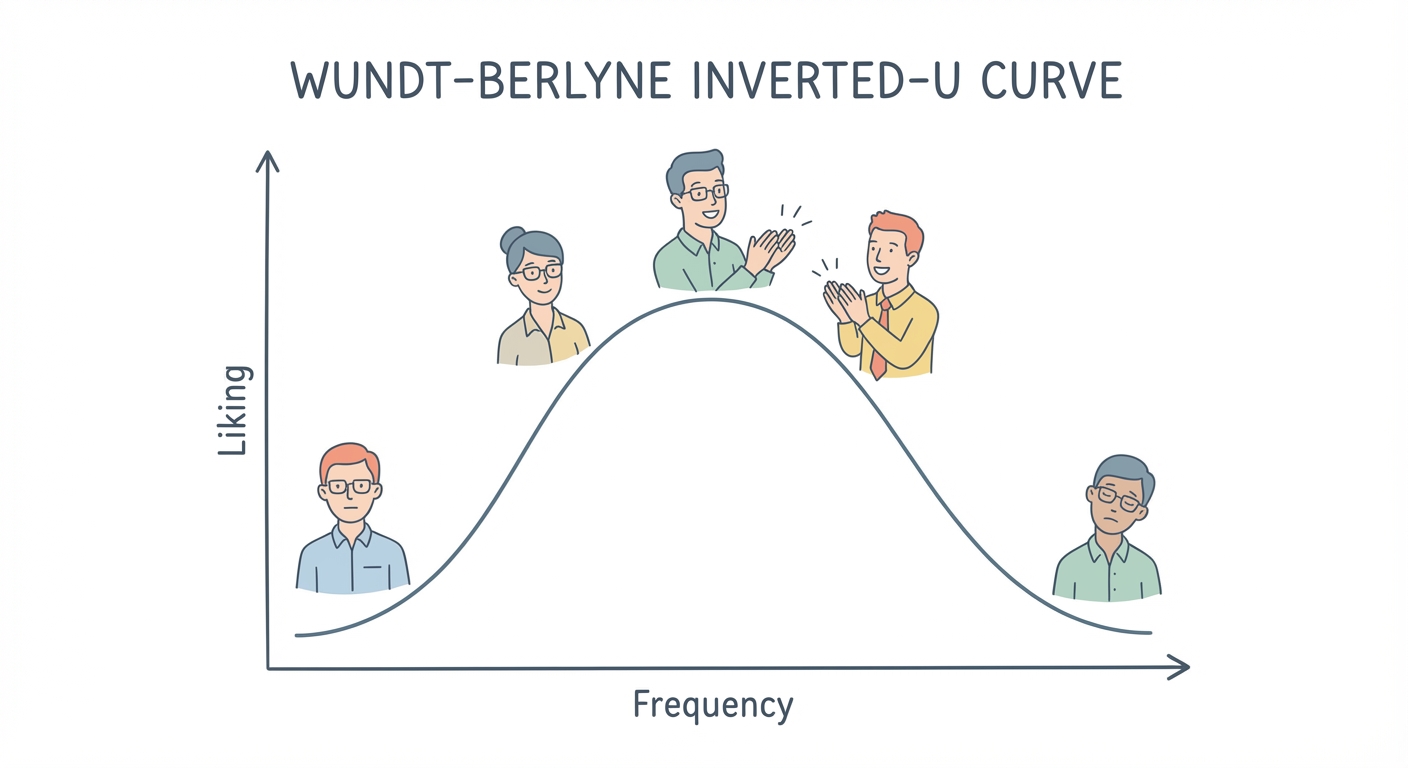
Look at the graph above. As frequency increases, the "hedonic value" (how much we like the stimulus) rises. This is the Habituation phase. But once it hits the peak—the optimal threshold—it doesn't just plateau. It crashes.
This downward slope is where boredom lives. Eventually, active hostility lives there too.
Most marketers unknowingly push their campaigns right off this cliff. They mistake the initial positive performance for a mandate to increase frequency, driving the user straight down the curve into the "negative hedonic" zone.
Why Familiarity Turns Into Contempt
Why does the brain turn on things it knows? Why doesn't the curve just stay flat? There are three psychological forces at play here, and they are stronger than your ad copy.
1. Semantic Satiation
You know this phenomenon. If you say the word "fork" fifty times in a row, it stops sounding like a piece of cutlery and starts sounding like meaningless noise. The neurons responsible for recognizing the word fatigue and stop firing efficiently.
The same happens with brand messaging. If a user sees your "20% Off" headline for the tenth time, the words lose their semantic meaning. They become visual white noise. The offer doesn't register as value anymore; it registers as a textured block of pixels blocking the content they actually want to see.
2. Psychological Reactance
This is the most dangerous factor. When a user feels they are being "stalked" by retargeting ads that follow them from Facebook to YouTube to a recipe blog, they experience Psychological Reactance.
Reactance is the brain's response to a perceived loss of freedom. When an ad appears too frequently, the user feels their autonomy is being threatened—that they are being coerced. The brain fights back to regain control.
How do they regain control? By actively hating the brand. They don't just ignore the ad; they develop a negative sentiment toward the company behind it.
3. The "Wear-Out" Effect
It is crucial to distinguish between two types of fatigue:
- Creative Wear-out: The user is bored of the specific image or video.
- Brand Wear-out: The user is sick of you.
Creative wear-out is fixable; you swap the image. Brand wear-out is a strategic failure. It means you have exhausted the audience's patience for your existence in their feed.
How to Identify Your Brand’s Repetition Threshold
The threshold isn't a fixed number. It isn't 7, and it isn't 4. It varies based on your creative quality, your industry, and the platform. You cannot guess it; you have to find it in the data.
Metric 1: CTR Decay
This is the canary in the coal mine. Watch your Click-Through Rate (CTR) over time for a specific ad set. In the beginning, CTR will likely rise or stay stable as the Mere Exposure Effect works.
The moment you see a consistent day-over-day drop in CTR while your targeting remains the same, you have hit the peak of the Wundt-Berlyne curve. You are now on the downward slope.
Metric 2: Frequency vs. Conversion
Stop looking at average frequency. An average frequency of 3 might hide the fact that 20% of your audience has seen the ad 15 times.
Break down your conversion data by frequency bucket.
- Conversions at Frequency 1-3: High
- Conversions at Frequency 4-6: Moderate
- Conversions at Frequency 7+: Zero
Find the number where the Cost Per Acquisition (CPA) exceeds your margin. That number is your hard cap.
Metric 3: The Negative Feedback Loop
Most platforms allow users to "Hide this ad." If your "Negative Feedback" or "Hide" rate begins to climb, you aren't just wasting money; you are poisoning the well. This signals that you have triggered Psychological Reactance.
Use this diagnostic logic to troubleshoot your campaigns:
Strategies to Extend Your Brand Threshold
The goal is not to stop advertising. The goal is to maintain the benefits of familiarity (trust) without triggering the penalties of fatigue (boredom). You want to stay at the peak of the curve for as long as possible.
Strategy 1: The Variation Heuristic
The brain tunes out static stimuli. It ignores the hum of the refrigerator because it never changes. To keep the brain engaged, you must introduce novelty within familiarity.
Keep the core message identical (to build memory structures) but change the delivery vehicle.
- Ad A: A video testimonial.
- Ad B: A flat lay image of the product.
- Ad C: A text-heavy graphic.
This resets the "boredom" timer. The user recognizes the brand (Familiarity) but has to process a new visual format (Novelty). This allows you to increase effective frequency without triggering wear-out.
Strategy 2: Platform Diversity
Context matters. If I see your brand three times in a row on Instagram Stories, you look desperate. You look like spam.
But if I see your brand once on Instagram, then I see a mention on LinkedIn, and then I receive an email? That feels like Omnichannel Presence. It signals authority. The repetition is spaced out across different contexts, which makes the brand feel "everywhere" in a premium way, rather than "everywhere" in an annoying way.
Strategy 3: Sequencing
Instead of hammering the user with the same "Buy Now" ad five times, use sequential messaging.
- Impression 1: The Problem (Educational)
- Impression 2: The Solution (Product Intro)
- Impression 3: Social Proof (Testimonial)
- Impression 4: The Offer (Discount)
This isn't repetition; it's a narrative. The user is following a story, so the fatigue threshold is significantly higher.
When Should You Intentionally Break Repetition?
There are two specific scenarios where you should throw the consistency rulebook out the window.
First, Rebranding. If your market has decided to ignore you (Semantic Satiation), doing "more of the same" is suicide. You need a Pattern Interrupt. You need to change the colors, the tone, and the logo to force the brain to re-evaluate the stimulus as "new" rather than "known."
Second, Crisis Management. If public sentiment turns negative, the Mere Exposure Effect works in reverse. Seeing a hated brand more often only reinforces the hate. In a crisis, repetition accelerates damage. The only move is silence or a complete pivot in messaging.
FAQ: Common Questions on Brand Frequency
1. What is the ideal frequency for Facebook ads before fatigue sets in? While it varies by industry, a frequency of 3-4 over a 7-day period is generally the "safe zone" for cold audiences. Once you creep above 5, you will usually see CPA spike and CTR plummet. Retargeting audiences (who already know you) can tolerate slightly higher frequencies, but proceed with caution.
2. Does the Mere Exposure Effect work for annoying ads? No. This is a common misconception. The Mere Exposure Effect only amplifies neutral or positive stimuli. If the initial reaction to your ad is negative (e.g., it's offensive, loud, or irrelevant), repetition will only deepen the dislike. You cannot annoy someone into buying from you.
3. How do I fix ad fatigue without spending more money on production? You don't always need a new photoshoot. You can rotate ad formats (turn a video into a carousel), change the first 3 seconds of the video (the hook), or simply write new headlines for the same image. Even changing the background color of a static ad can be enough to reset the user's attention.
4. Is there a difference between B2B and B2C repetition thresholds? Yes. B2B sales cycles are long and logic-driven. A B2B buyer might need 10+ touchpoints over six months to build enough trust to book a demo. B2C, especially for lower-ticket items, relies on impulse. If they haven't bought a $30 t-shirt after seeing it 5 times, they probably never will.